Law of Sowing and Reaping
Crazy Mama: 9 Steps to a Not-So-Normal LifeThe Law of Sowing and Reaping presents generosity as both a way of treating others and the condition for keeping blessing in motion. Its central claim is reciprocal: people reap in proportion to what they sow, so those who want to receive blessing should first become a blessing to others. The book develops that claim through familiar images—seeds, harvests, a missing cooking pot filled with sludge, and the contrast between a pipe and a bucket—making giving not an optional addition to prosperity but the practice that sustains it.
Definition and Scriptural Basis
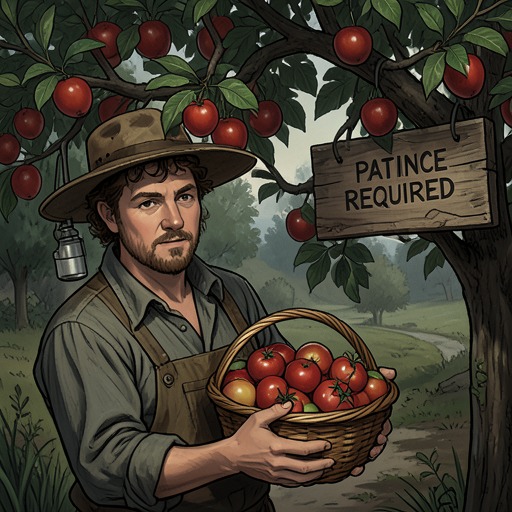
The principle is introduced as a law in effect from the beginning of time, illustrated by the predictable relationship between seed and crop: sunflower seeds produce sunflowers, and watermelon seeds produce watermelons. The analogy establishes the rule’s basic logic. What is planted determines the kind of harvest that follows; the result is not interchangeable with the original act.
The book then connects this natural pattern to scripture, citing 2 Corinthians 9:6. The passage contrasts sowing sparingly and grudgingly with sowing generously so that blessing may come to someone: the former leads to a meager harvest, while the latter leads to a generous one. The emphasis is not merely on giving as a private virtue. The purpose of generosity is explicitly outward-facing, directed toward another person’s blessing, and the promised return follows that giving.
The author condenses the principle into the claim that people get what they give. Rather than treating advancement as a contest in which each person pushes ahead at another’s expense, the book argues that generosity is the path to blessing. This reverses the self-protective instinct to look out for oneself first: giving is presented not as a loss opposed to receiving, but as the action that sets the cycle of receiving in motion.
The Practice of Being a Blessing
The law is framed as something that must be practiced in ordinary situations, not simply agreed with in theory. The book describes people who affirm the principle but then become angry when they cannot get a parking space near the entrance or receive good service at a restaurant. These small frustrations expose a gap between assent and conduct. A person may nod at a teaching about generosity while still measuring daily life by the convenience and consideration personally received.
Against that gap, the instruction is direct: anyone who wants to be blessed must be a blessing. The teaching shifts attention away from waiting for favorable treatment and toward the person’s own conduct toward others. In this account, generosity is not confined to a single dramatic gift; it is a governing orientation that should shape how people act in the ordinary exchanges of life.
Pipes, Buckets, and Stagnation
The book gives the principle a physical image through a recurring household problem. The author’s children make concoctions outside and use good pots and pans for them. When a pot goes missing, it is eventually found outdoors full of mucky sludge and must be cleaned before it can be used again. The problem is not simply that something has been stored; it is that material has collected, grown stale, and become foul.
That image becomes a distinction between a channel and a container. People, the book argues, are not placed on earth to collect blessing but to let it flow through them. If blessing enters a life and is never passed on, the flow eventually stops; what has been accumulated stagnates. The mud-filled pot makes the consequence tangible: possession without circulation can turn something useful into something unpleasant and unusable.
The section titled Pipes, Not Buckets sharpens the contrast. A pipe allows blessing to move through; a bucket gathers and retains it until it grows stale. The book assigns different roles within this metaphor: the person’s task is to be a blessing, while the divine source is responsible for blessing. Generous sowing and generous reaping are thus linked through movement rather than accumulation. The desired return does not make giving self-sufficient or mechanical in the book’s account; the person gives, and blessing is said to continue flowing under divine care.
Reciprocity and the Book’s Wider Argument
The Law of Sowing and Reaping joins an uncomplicated cause-and-effect image to a broader claim about how to live. Seed corresponds to harvest, generosity to blessing, and withholding to a diminished return. The repeated comparisons make the claim memorable, while the household pot supplies a cautionary counterimage: what is kept from flowing does not remain fresh simply because it has been retained.
The teaching also appears within the book’s broader language of blessing as something available to be claimed and received. An anecdote about a previously overlooked payment describes a man who studies a contract, discovers more than $3,000 due, and helps secure it; the resulting benefit is described as blessing both parties. That episode concerns the discovery of what was owed, not a direct demonstration of the sowing-and-reaping rule, but it echoes the book’s larger attention to blessing as something that can be recognized, received, and shared.
The law’s decisive emphasis remains on the movement outward. It rejects the assumption that a person prospers by pushing others aside and insists instead that generosity is integral to receiving. Its images progress from seed to harvest and from a sludge-filled pot to an open channel, turning reciprocity into a practical discipline: blessing is not meant to end with the person who receives it.